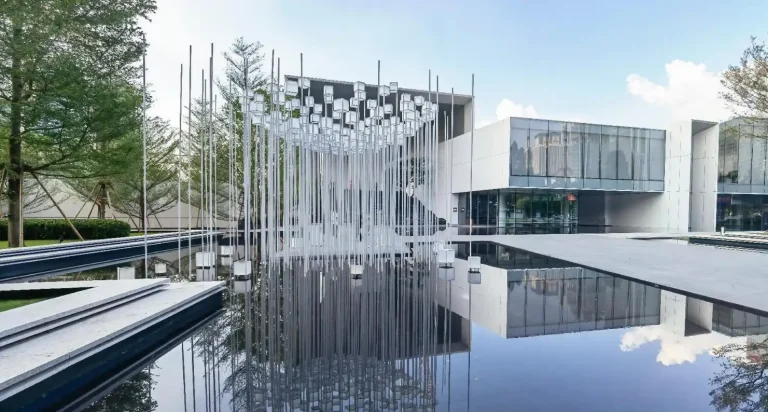
When commissioning a sculpture for a commercial plaza, hotel lobby, or theme park, one of the first and most important decisions is material selection. Two of the most popular options are fiberglass-reinforced plastic (FRP) and stainless steel. While stainless steel is often the go-to for permanent outdoor installations, fiberglass has distinct advantages that make it the superior choice in many scenarios.
This article is written by WEMEDEC team and explains what fiberglass is, explores its key characteristics, and compares it to stainless steel to help you determine which material is right for your project.
1. What is Fiberglass? Definition and Chemical Composition
Fiberglass (also known as glass-reinforced plastic or GRP) is a composite material made of two primary components:
- Glass fibers – These provide strength and structural reinforcement. The fibers can be randomly arranged, woven into cloth, or formed into mats.
- A polymer resin matrix – This binds the fibers together and protects them. Common resins include polyester, epoxy, and vinyl ester, which are thermosetting polymers.
The combination results in a material that is stronger than many metals by weight, lightweight, chemically inert, and capable of being molded into virtually any shape.
A Brief History: When Did Fiberglass Become Widely Used in Sculpture?
Although glass fibers have been produced for centuries, the modern history of fiberglass composites began in the 1930s. In 1932, a researcher at Owens-Illinois accidentally discovered a method for mass-producing glass strands by directing compressed air at molten glass. Owens later merged with Corning to form Owens Corning, which patented its “Fiberglas” material in 1936.
The development of a suitable polyester resin by DuPont in 1936 made it possible to combine glass fibers with plastic to create a true composite material. During World War II, fiberglass was used in aircraft radomes due to its transparency to microwaves—a breakthrough that demonstrated its structural potential. Its first major civilian application came in the 1950s for boat hulls and sports car bodies. By the 1960s and 1970s, advances in manufacturing, including the pultrusion process, made fiberglass more cost-effective and widely adopted across industries, including construction and automotive. – Said Mr. Jin, an engineer in WEMEDEC company.
In the art and sculpture world, fiberglass gained popularity in the late 20th century as artists and fabricators recognized its lightweight, moldability, and cost advantages over traditional materials like bronze and stone. Today, it is a standard material for custom sculptures, themed environments, and commercial decorations.


2. Key Characteristics of Fiberglass Sculptures
To understand when fiberglass is the better choice, it helps to examine its defining features across several dimensions.
2.1 Shape and Formability
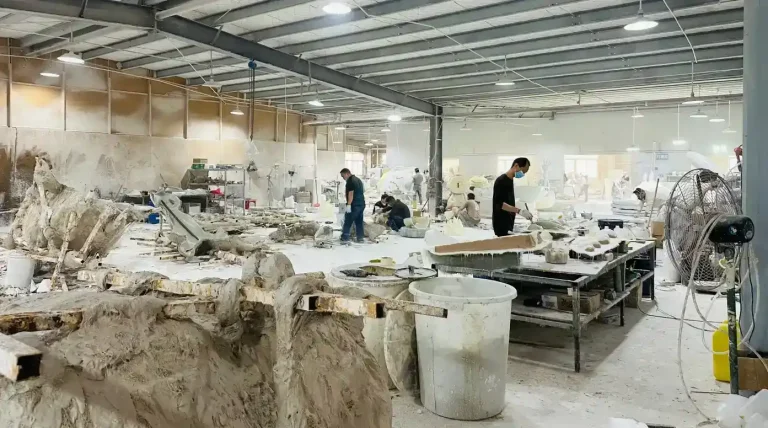
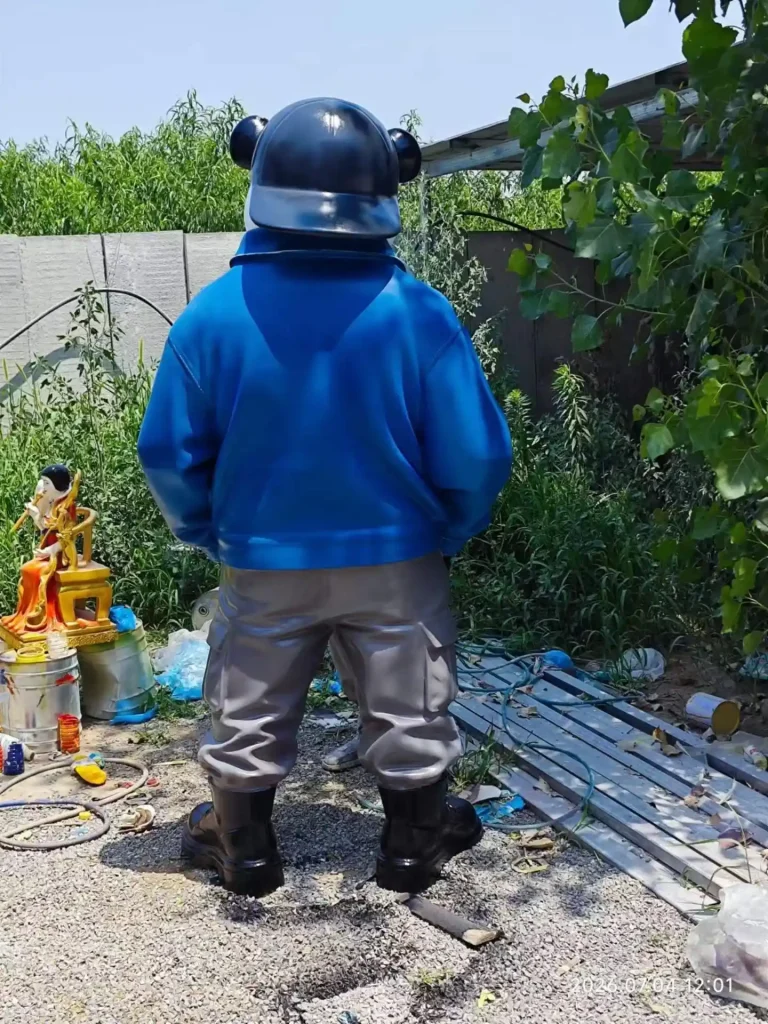
One of fiberglass’s greatest strengths is its unmatched design flexibility. Unlike metals that require cutting, welding, and forging, fiberglass can be molded into complex, organic, and highly detailed shapes with crisp detailing. Molds are made directly from clay models or 3D-printed masters, allowing for intricate textures, flowing curves, and undercuts that are difficult or impossible to achieve in metal. This makes FRP ideal for cartoon characters, animal sculptures with lifelike fur textures, and abstract organic forms.
2.2 Physical Characteristics: Weight
Fiberglass is significantly lighter than stainless steel. The density of FRP is roughly 1.5–2.0 g/cm³, compared to stainless steel at about 7.9 g/cm³. This lightweight property makes fiberglass sculptures:
- Easier to transport and handle – reducing shipping costs and logistical complexity.
- Easier to install – requiring less heavy lifting equipment and lighter foundations.
- Safer for overhead or suspended installations – reducing structural load.
2.3 Surface Finishing Options
Fiberglass offers extensive surface treatment possibilities:
- Painted finishes – Automotive-grade paints, clear coats, and durable varnishes can create high-gloss, matte, or textured surfaces in any color.
- Metallic effects – Electroplating or metallic paints can mimic the look of metal, stone, or other materials.
- Gel coats – Pigmented resin layers applied during molding provide a durable, colored surface.
Unlike stainless steel, which relies on the metal’s natural luster or polished/matte finishes, fiberglass can be painted to match exact brand colors, themes, or artistic visions.
2.4 Cost
WEMEDEC team explains, fiberglass is generally much more affordable than stainless steel. The lower cost stems from:
- Cheaper raw materials (resin and glass fibers vs. alloyed metals).
- Less labor-intensive fabrication (molding vs. forging/welding).
- Lower transportation costs due to lighter weight.
For budget-conscious projects, custom designs, or large quantities, FRP offers an economical solution without sacrificing visual impact.
2.5 Lead Time
Fiberglass sculptures typically have shorter production lead times than stainless steel. The molding process allows for faster replication of designs, whereas stainless steel sculptures often require extensive metalworking, welding, and finishing. Once a mold is created, multiple copies can be produced quickly—a clear advantage for commercial decor chains, event installations, or time-sensitive projects.
2.6 Service Life and Durability
This is where fiberglass has notable limitations. Standard fiberglass sculptures are susceptible to UV degradation and weathering over time. Prolonged sun exposure can cause the resin to fade, chalk, or become brittle. Without proper protective coatings (UV-resistant clear coats or paints), an FRP sculpture may show signs of aging within 5–10 years. However, with high-quality automotive paints and UV sealants, lifespan can be extended to 10 years or more.
In contrast, stainless steel can last several decades to over 100 years with minimal maintenance.

3. Fiberglass vs. Stainless Steel Sculptures: Advantages and Disadvantages
3.1 Advantages of Fiberglass Over Stainless Steel
| 3.1 Advantages of Fiberglass Over Stainless Steel | ||
| Factor | Fiberglass (FRP) | Stainless Steel |
| Cost | Lower – Affordable for large-scale or multiple units | Higher – Expensive materials + labor |
| Weight | Lightweight – Easier to ship, handle, and install | Heavy – Requires robust foundations and lifting equipment |
| Design Flexibility | Superior – Complex shapes, fine details, organic forms, textures | Limited – Primarily geometric, abstract, or simpler curves |
| Lead Time | Shorter – Faster production, especially for multiple copies | Longer – Labor-intensive metalworking |
| Color & Finish Options | Unlimited – Any color, pattern, or finish; can mimic other materials | Limited – Natural silver/gray; color requires painting or coatings |
| Surface Detail | Crisp, intricate detail possible directly from the mold | Details are labor-intensive to achieve |
| 3.2 Disadvantages of Fiberglass Compared to Stainless Steel | ||
| Factor | Fiberglass (FRP) | Stainless Steel |
| Long-Term Outdoor Durability | Lower – Prone to UV degradation, chalking, and brittleness over time | Excellent – Decades to 100+ years lifespan; corrosion-resistant |
| Impact Resistance | Lower – Can crack, chip, or fracture under strong impact | High – Tough, impact-resistant metal |
| Structural Strength | Moderate – Suitable for non-loadbearing applications; may require internal reinforcement for large panels | High – Can support heavy loads and withstand extreme weather |
| Maintenance | Periodic – Requires recoating or repainting over time | Low – Occasional cleaning; no repainting needed |
| Perception | Sometimes seen as “less premium” than metal | Associated with modern, prestigious, high-end design |
| Fire Resistance | Limited – Resin matrix is combustible (though fire-retardant grades exist) | Non-combustible |
Contact WEMEDEC for more details.
4. When to Choose Fiberglass Over Stainless Steel
Based on the comparison above, fiberglass is the better choice in the following situations:
- When Budget is a Priority. If your project has limited funding or requires multiple large sculptures, FRP offers the best visual impact per dollar.
- For Complex, Detailed, or Organic Shapes. Cartoon characters, lifelike animal sculptures, fantastical creatures, and intricate floral designs are far easier and cheaper to achieve in fiberglass.
- When Weight is a Concern. For rooftop installations, suspended displays, or sites with poor soil conditions for heavy foundations, fiberglass’s lightweight nature is a major advantage.
- For Indoor or Short-Term Outdoor Use. Hotel lobbies, shopping malls, cafes, and event displays benefit from FRP’s design versatility without the need for decades of outdoor weathering resistance. Even outdoor commercial installations (like children’s play areas or themed attractions) often use FRP with high-quality protective coatings.
- For Color-Matched Branding. If your sculpture needs to match specific brand colors or incorporate detailed painted graphics, fiberglass is far easier to paint and repaint than stainless steel.
5. When Stainless Steel is the Better Choice
Stainless steel is preferable for:
- Permanent outdoor installations in harsh environments (coastal areas, rainy climates).
- Large-scale abstract or minimalist sculptures where the metal’s natural luster and reflective properties are central to the design.
- High-traffic public spaces where impact resistance and durability are critical.
- Projects with higher budgets seeking a premium, modern aesthetic.
Conclusion
Fiberglass is a versatile, cost-effective, and lightweight material that excels in creating detailed, colorful, and complex sculptures for both indoor and outdoor settings. However, its susceptibility to UV degradation over time means it is best suited for projects where cost, weight, and design flexibility outweigh the need for multi-decade outdoor permanence.
Stainless steel, on the other hand, is the undisputed champion of long-term outdoor durability and structural strength. It is the premium choice for permanent public art that will weather time and elements.
Ultimately, the decision should be guided by your project’s budget, site conditions, design requirements, and expected lifespan. For many commercial, themed, and short-to-medium-term public art projects, fiberglass is not just an alternative—it is often the best choice.
“Together we co-create the space”. WEMEDEC is specialized in space design and improvement with quality sculptures of stainless steel materials, brass and bronze materials, FRP materials, and metal shades and canopies, pergola and metal structures for various applications. At present WEMEDEC is looking for global business partners, we expect you to send messages to us.