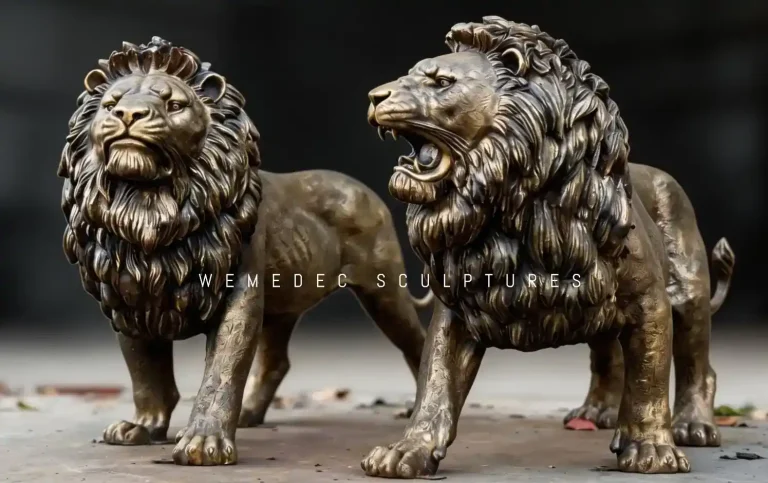
In the realm of public art, architectural features, and landscape design, stainless steel sculptures stand out for their modernity, durability, and striking visual impact. Whether gracing a city plaza, a corporate campus, or a private garden, a well-crafted stainless steel sculpture becomes a timeless landmark. However, not all sculptures are created equal. The disparity in quality can be significant, impacting not only the artwork’s aesthetics but also its longevity and safety. As a specialist in spatial design and fabrication, WEMEDEC understands that discerning quality is paramount for clients. This guide will delve into the critical factors that determine the quality of a stainless steel sculpture: Material & Gauge Thickness, Surface Finish, and Internal Structural Framework.
1. Material Selection and Gauge Thickness: The Foundation of Durability
The choice of stainless-steel grade and the thickness of the metal sheets (gauge) form the very foundation of a sculpture’s quality and suitability for its environment.
- Understanding Stainless Steel Grades: SS201, SS304, SS316, and 316L
Stainless steel sculptures are typically fabricated from austenitic grades, with common types being SS201, SS304, SS316, and SS316L. Their quality and properties ascend in that order.
SS201: This is an economical grade containing manganese and nitrogen. It is relatively softer and offers less formability and visual “presence” compared to the 300 series. Its corrosion resistance is lower, making it less ideal for permanent outdoor installations, especially in demanding environments. It may be considered for short-term or indoor decorative pieces where budget is a primary constraint.
SS304: The most widely used grade for metal sculptures. Type 304 offers excellent corrosion resistance, good formability, and a favorable strength-to-weight ratio. It is highly suitable for a vast majority of outdoor applications in urban and suburban settings. Its performance is reliable against atmospheric pollution and rain.
SS316 & SS316L: These are the premium choices for superior corrosion resistance. The key difference from SS304 is the addition of molybdenum (2-3%). This element drastically enhances resistance to chlorides and acidic environments. SS316 is the unequivocal recommendation for coastal, marine, or industrial areas. A sculpture made from SS316 can withstand salty sea air for decades without significant corrosion. SS316L, with lower carbon content, offers even better resistance to sensitization (granular corrosion) during welding, making it the top-tier choice for critical applications where weld integrity is paramount. While SS304 can function in coastal areas if protected by a robust paint system (not mere polishing or brushing), SS316/316L provides inherent, long-term security.
Practical Consideration: For smaller, intricate sculptures requiring extensive hand-forging, SS304 can sometimes be preferred. SS316, being slightly harder, demands more time and effort from skilled artisans during the shaping process, which can affect project timelines and costs. The choice, therefore, balances environmental needs with artistic and practical constraints.
B. The Critical Role of Gauge Thickness
The thickness of the stainless-steel sheets is not merely a cost factor; it is integral to the sculpture’s structural integrity, visual solidity, and manufacturability. Common thicknesses include 2mm, 2.5mm, 3mm, and 5mm.
Size-Based Guidelines:
Small to Medium Sculptures (e.g., 1-3 meters tall): A thickness of 2mm to 2.5mm is generally adequate. We often recommend 2.5mm as a standard for its optimal balance of strength, weight, and workability.
Large Sculptures (over 3 meters tall): 3mm thickness is strongly advised to ensure rigidity and resist wind loads or accidental impact.
Monumental or Architectural-Scale Sculptures (e.g., 7-8 meters tall, especially with complex curves): 5mm or thicker material should be considered. This provides immense structural capacity and a sense of permanence.
Manufacturing & Finish Implications: Gauge thickness directly impacts the final finish quality. For sculptures with significant curves or complex geometry, the polishing process can cause slight wear on the surface material. If the initial gauge is too thin, achieving a flawless, deep mirror polish becomes challenging, as underlying imperfections or the ‘orange peel’ effect from welding may be difficult to grind out completely. A thicker gauge allows artisans more material to work with during grinding and polishing, facilitating a superior, blemish-free finish. It ensures the surface remains robust and true after extensive handwork.
2. Surface Finish: The Art of Perfection
The surface treatment defines the sculpture’s character, light interaction, and perceived value. Common techniques include Mirror Polishing, Brushed Finish, Satin Finish, Textured Patterns, Painting, Electroplating, and PVD Coating.
A. Mirror Polishing: The Benchmark of Craftsmanship
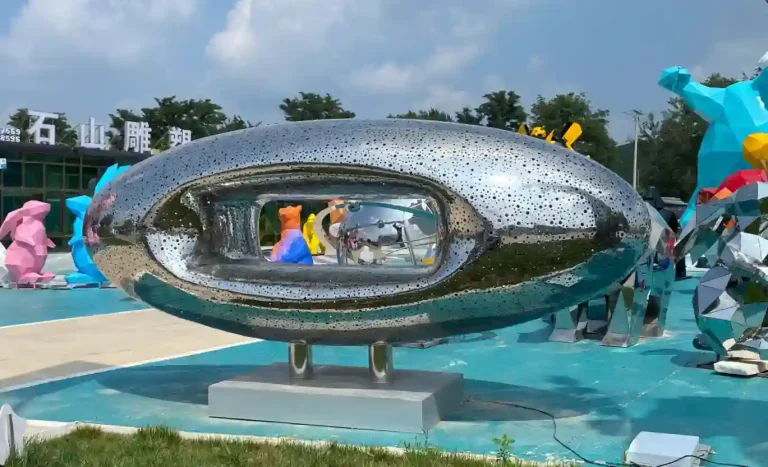
This is the most sought-after finish, creating a reflective, liquid-metal appearance. Its quality is a direct testament to the preceding fabrication stages:
Forging & Hammering: Artisans must shape the metal sheets fluidly and uniformly. Any unevenness, dents, or inconsistent curvature will be glaringly magnified after polishing.
Welding & Assembly: The joining of sculptural components requires exceptionally skilled TIG (Tungsten Inert Gas) welding. Seams must be continuous, smooth, and perfectly blended. Poor welding results in visible ridges, pits, or discoloration that are extremely difficult to polish out.
The Polishing Process Itself: This is a labor-intensive art. Starting with coarse abrasives and progressing through finer grits to final buffing compounds, the polisher’s experience is crucial. A master polisher understands how to handle complex contours, maintain even pressure, and achieve a truly flat, distortion-free mirror surface. They ensure the sculpture reflects its surroundings beautifully, not like a funhouse mirror.
B. Electroplating and Other Coatings: An Even Higher Bar
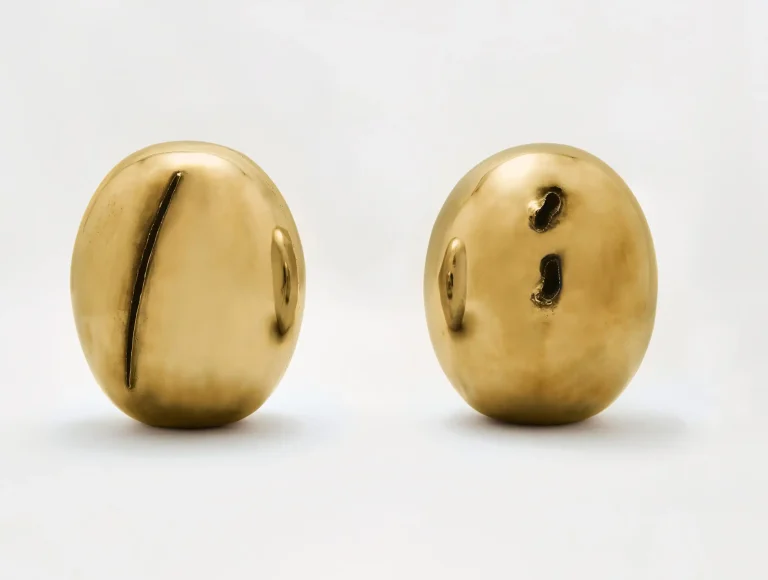
Applying a colored electroplate (e.g., gold, bronze, black chrome) or PVD coating imposes even stricter demands. These processes are less forgiving than standard polishing. Any minor scratch, pit, or graininess on the underlying stainless steel will be accentuated, not concealed, by the thin plating layer. The substrate must be prepared to an immaculate, near-perfect polished state before plating. A flawed plating job often necessitates complete stripping and re-polishing—a costly and time-consuming rework.
3. Internal Structural Framework: The Invisible Backbone
Often overlooked but fundamentally critical, the internal support structure (or armature) is what guarantees the sculpture’s stability, safety, and longevity. It bears all environmental loads—wind, seismic activity, and its own weight.
Material compatibility matters. The structural material must be matched to the installation environment. This is non-negotiable.
For a sculpture destined for a coastal villa or island, specifying a SS316 or 316L internal frame and anchoring system is essential. Using galvanized steel or even SS304 here is a severe compromise, as these will corrode from within when exposed to salty, moist soil and air, leading to catastrophic failure.
For standard inland environments, hot-dip galvanized steel or SS304 structures are acceptable, provided the base is properly isolated from ground moisture.
Engineering design is vital too. A well-designed internal framework is not just a copy of the sculpture’s shape. It must be optimized for load paths, weight distribution, and connection points. A qualified structural engineer is indispensable. They calculate wind loads, design vibration damping if necessary, and ensure the sculpture can withstand local climatic conditions for decades. The framework must allow for thermal expansion and contraction of the outer skin.
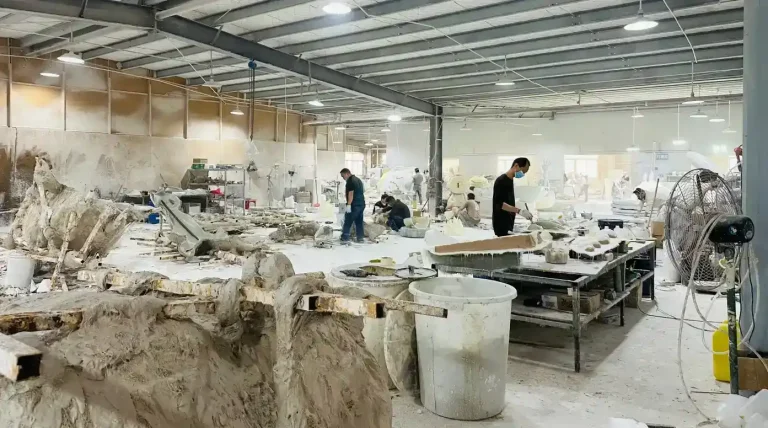
The Role of Detailed Design is important. Before fabrication begins, experienced detailers and design engineers translate the artist’s concept into buildable technical drawings. They plan the segmentation of metal sheets, the placement of seams for minimal visual impact, and the integration of the internal structure with the outer skin. This stage prevents costly errors during production.
WEMEDEC: Your Partner for Excellence in Spatial Art and Design
Understanding these three pillars—Material & Gauge, Surface Finish, and Internal Structure—empowers you to evaluate proposals and craftsmanship objectively. At WEMEDEC, our journey began with a deep specialization in sculpture fabrication, mastering the nuances of both stainless steel and cast bronze. This foundational expertise in material science, metallurgy, and hands-on artistry informs everything we do.
As global markets have evolved, so have we. Driven by a vision to create holistic spatial experiences, WEMEDEC has expanded into comprehensive landscape design and interior design services. Furthermore, we supply innovative products that complement these spaces, including*travel-themed pods, stargazing PC domes, high-end outdoor furniture, and architectural lighting.
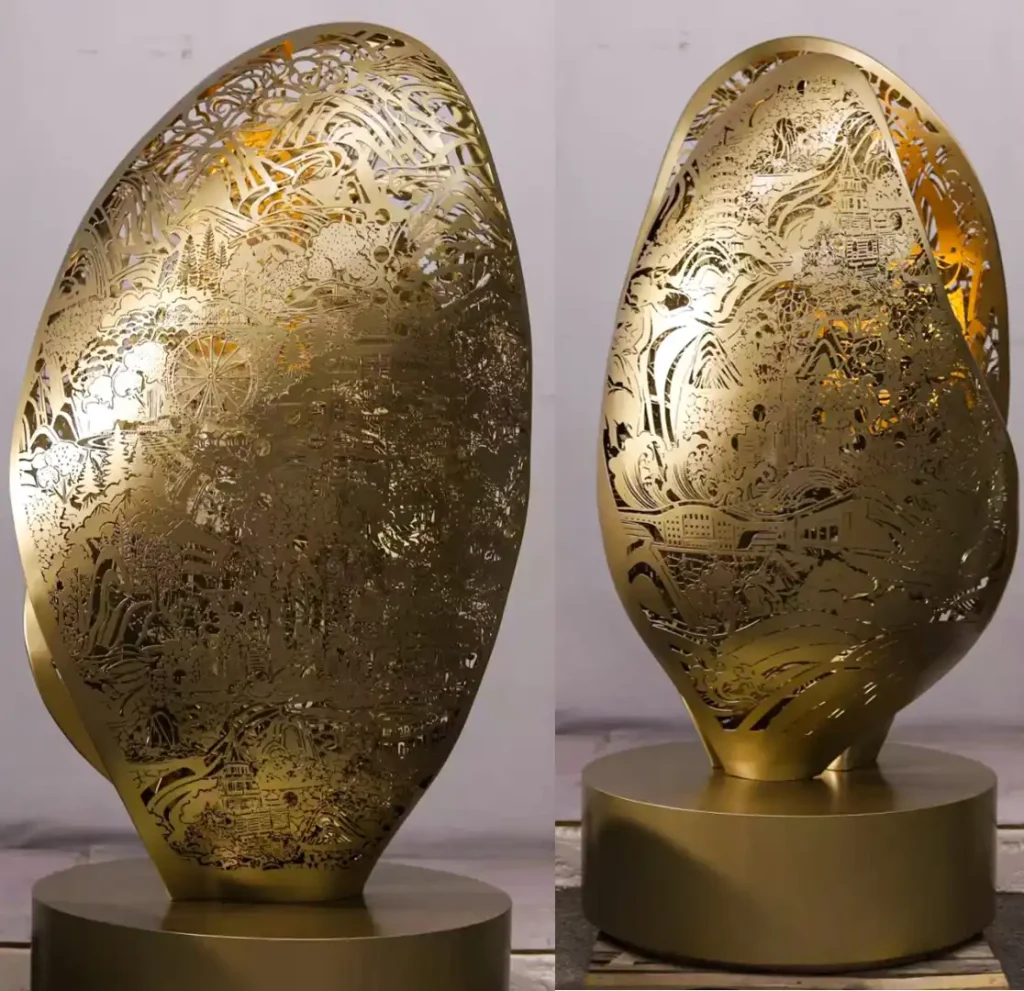

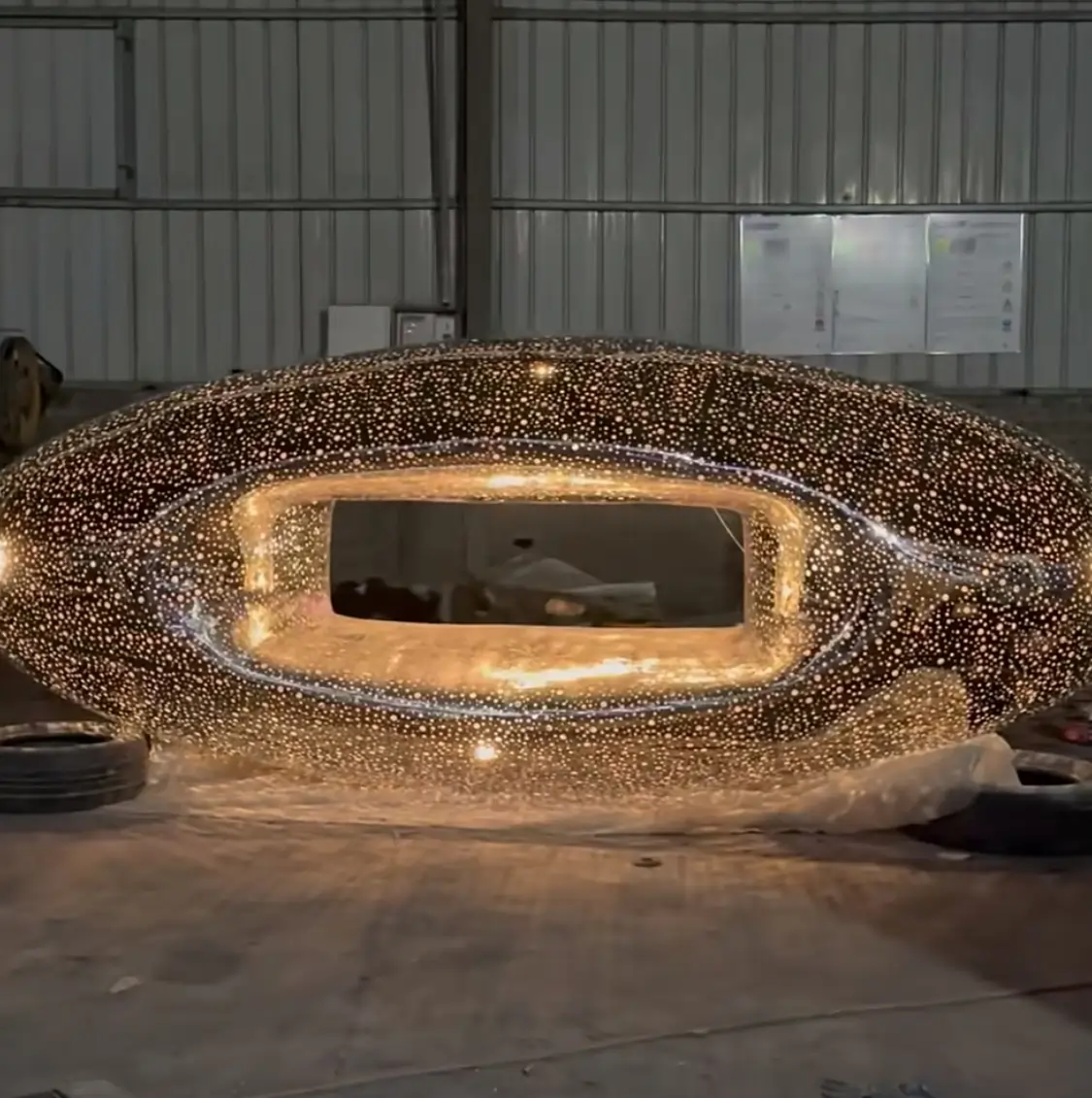
The WEMEDEC team has our own structural designers, detailed designers, 3D modeling engineers, and more — a dedicated professional group that many smaller companies currently lack. What are you waiting for? Get in touch with us today!
Engineer. JIA Zhao Min
This synergy allows us to offer truly integrated, one-stop solutions. Whether your project requires a breathtaking centerpiece sculpture, a fully realized thematic environment, or curated site furnishings, we provide creative, coherent designs paired with rigorous, uncompromising quality control. From the initial sketch to the final installation, every detail is meticulously managed, ensuring the structural integrity, aesthetic beauty, and enduring value of our work.
We invite you to consult with our team of artists, engineers, and designers. Let WEMEDEC transform your vision into an enduring symbol of quality and innovation.